
Say "Milton Keynes" to someone who has never been, and you get one of two things back. Roundabouts, or concrete cows.
The cows have been the city's punchline for nearly fifty years. A comedian says "concrete cows" and the audience laughs, because everyone thinks they know the joke: some cold-hearted planner dropped fake cows into a fake town, because there was nothing real left.
That story is wrong. Almost every part of it.
The real story is stranger, funnier and a lot warmer than the joke. It involves an American artist, a group of local schoolkids, a scrapyard, a student rag week kidnapping, and a herd that has been beheaded, striped like zebras, dressed in pyjamas and painted as skeletons.
Here is what actually happened.
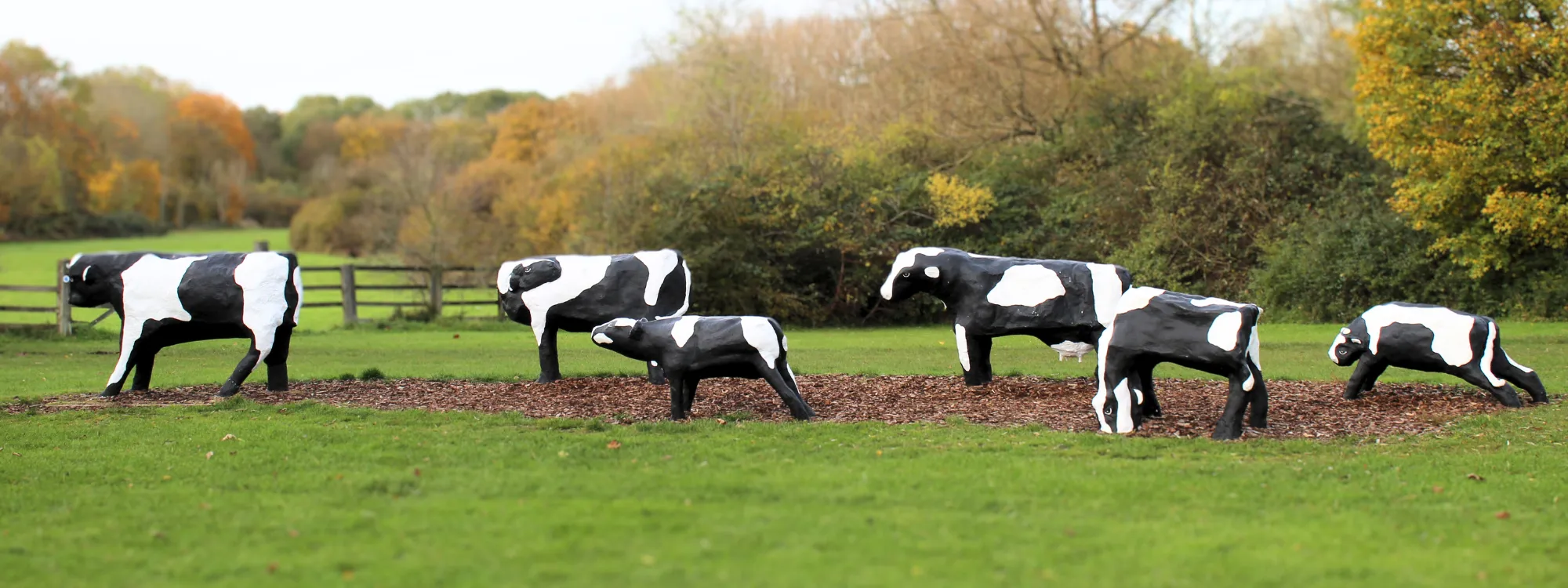
There are six of them. Three cows and three calves.
The first thing people get wrong is the size. Everyone pictures something monumental, a big grey slab of a beast. They are roughly half life size. Stand next to one and it comes up to about your waist. They are small, a bit lumpy, and honestly quite sweet.
The second thing people get wrong is what they are made of. The originals were built around a frame of scrap, then skinned in fibreglass-reinforced concrete donated by a local builder. They were not cast in a factory. They were made by hand, on a budget, out of whatever was going.
Who made them, and why
They were made in 1978 by Liz Leyh, an American artist who came to Milton Keynes in 1974 as artist in residence, funded by the Arts Council and the Milton Keynes Development Corporation. Her job was to get people making things. Murals, sculptures, community work, that sort of thing.
She did not make the cows alone. She made them with local schoolchildren. The herd was unveiled on 3 September 1978.
And that is the part the joke always misses. The cows were not a planner's cynical statement about the death of the countryside. They were a community art project. A gift. Kids from the new estates, in a city that was still half building site, making something daft and lovely to put on a bit of grass.
Leyh reportedly did not much care for the fame that followed. She made a small, funny, generous thing, and the whole country turned it into a stick to beat her adopted city with.
The myth, and why it stuck
The joke works because it flatters a certain kind of person. Milton Keynes is new, and Britain is deeply suspicious of new. A city with straight roads and a grid system and no cathedral was never going to get an easy ride.
So the cows became shorthand. Concrete cows, concrete city, no soul, no history, no nature.
Here is the awkward bit for anyone still telling that joke in 2026.
Milton Keynes has more than 22 million trees. It has over 6,000 acres of parkland, woodland, river valleys and lakes, all looked after by The Parks Trust, a charity set up in 1992 with a 999 year lease and its own endowment, deliberately kept separate from the council so that no future administration could sell the green off. Not a single acre of it is funded by your council tax.
Whoever planned this place did a lot of things you can argue with. Leaving no room for nature was not one of them. The green was baked in from day one and then legally protected for a thousand years.
Concrete city. Right.
The pranks: a short and violent history
The cows have taken a beating. They are probably the most vandalised, most kidnapped, most redecorated public art in Britain, and most of it has been done with affection.
They have been painted as zebras. Black and white stripes, top to tail.
They have been dressed in pyjamas. Painted on, pyjama bottoms, which is somehow funnier than the real thing.
Someone attached a papier mâché bull to one of them. This did not end well for the cow's hindquarters.
They have been beheaded. Fully decapitated. They had to be rebuilt by Lesley Bonner, one of the people who had helped build them in the first place, which is a nice bit of circularity even if the reason for it is grim.
One was kidnapped for ransom in 1988. A calf called Millie Moo Two was taken in a midnight raid on the field. It was students, doing rag week. The plan was a £50 ransom note to the Development Corporation. The Corporation offered to just have the calf back, the students accepted, and Millie Moo Two came home on 19 June. One of the students admitted afterwards that the real prize was the publicity for rag week. Honestly, fair enough.
In 2012 they were painted as skeletons. This one landed badly. It was close enough to Halloween to be a gag, but it was serious enough that officials openly discussed whether the herd should be removed for good.
They were not removed. They came back. They always come back.
Which cows are you actually looking at
This trips up almost everybody, including plenty of locals.
The cows standing on the grass at Bancroft today are not Liz Leyh's originals. The originals took so much punishment that in the 1980s a local artist, Bill Billings, was asked to build a tougher herd using concrete and wire mesh. That is the herd out in the open now.
Leyh's original 1978 cows are safe indoors at Milton Keynes Museum in Wolverton. If you want to see the actual things the schoolkids helped make, that is where you go.
The Bancroft herd went off for restoration and came back to its field in 2016, and The Parks Trust look after them now.
So there are two answers to "where are the concrete cows", and both are correct. The famous ones are at Bancroft. The real ones are at the museum.
Where to find them
The herd at Bancroft graze on the grass beside Monks Way (the A422), between Great Monks Street (V5) and Grafton Street (V6), near where the road passes under the railway line. They sit in Loughton Valley Park. Park up, walk over, take the photo. It takes ten minutes and it costs nothing.
While you are there, the redway network runs right through the valley, so it is an easy one to fold into a walk along the brook rather than a drive-by.
The originals are at Milton Keynes Museum in Wolverton, along with a lot of other MK history that deserves more attention than the cows get.
The joke is old. The cows are fine.
Here is what fifty years of taking the mickey out of Milton Keynes has not managed to do. It has not stopped anybody moving here. It has not stopped the gigs, the club nights, the festivals, the charities, the food, the football, the theatre, or the several hundred things happening in this city on any given weekend.
And it has not killed the cows. Six half-size concrete animals, made by an American artist and a load of local kids on a patch of grass in 1978, have outlasted every comedian who ever used them as a punchline.
That is not a joke about Milton Keynes. That is Milton Keynes.
Published by MK Life, an independent Milton Keynes city guide. Details correct at time of publishing.